As accounting firms grow, client onboarding often becomes a hidden bottleneck. What starts as a simple phone call and a few follow‑up emails can quickly turn into a time‑consuming process filled with missing information, manual data entry, and unnecessary back‑and‑forth.
In this client project, we worked with an accounting firm to modernise their new‑client onboarding using Jotform. The goal was simple: collect the right information upfront, reduce admin time, and create a more professional first impression for new clients.
The Client
The client is a Brisbane based boutique accounting practice servicing SME's in Queensland and Interstate across a range of structures, including:- Sole traders
- Partnerships
- Companies
- Trusts
The Challenge
Prior to this project, the firm relied on an intial phone call and then subsequent emails to new clients at the start of the engagement.This approach created several challenges:
- Clients were needing to be contacted multiple times
- Key details such as ABNs, director information, and trust documentation were often missing or incomplete
- Staff spent significant time following up answers and clarifying responses
- Adapted to different business structures
- Reduced manual handling
- Improved accuracy and consistency of client data
- Reflected a more modern, professional brand
The Solution
We designed and implemented a smart new‑client onboarding form using Jotform, built specifically for Australian accounting requirements.The form was structured into logical sections and used conditional logic so clients only saw questions relevant to their business structure.This ensured the onboarding process felt shorter and clearer for clients, while still capturing all required information for the accounting team.How the Jotform Was Built
Business Structure Selection
The form begins by asking clients to select their business structure:- Sole Trader
- Partnership
- Company
- Trust
Sole Trader Onboarding Path
When a client selects Sole Trader, the form displays questions relevant to individual business owners, including:- Full name of the individual
- ABN
- Date business commenced
- GST registration status
- Business address
Partnership Onboarding Path
For partnerships, the form dynamically expands to capture:- Partnership name (if applicable)
- ABN
- Trading name
- Partner details (with the ability to add multiple partners)
- GST registration details
Company Onboarding Path
Clients operating as a company are guided through a tailored set of questions, including:- Company name and ACN
- Registered office address
- Director details (with support for multiple directors)
- Shareholder information
- ASIC annual review date
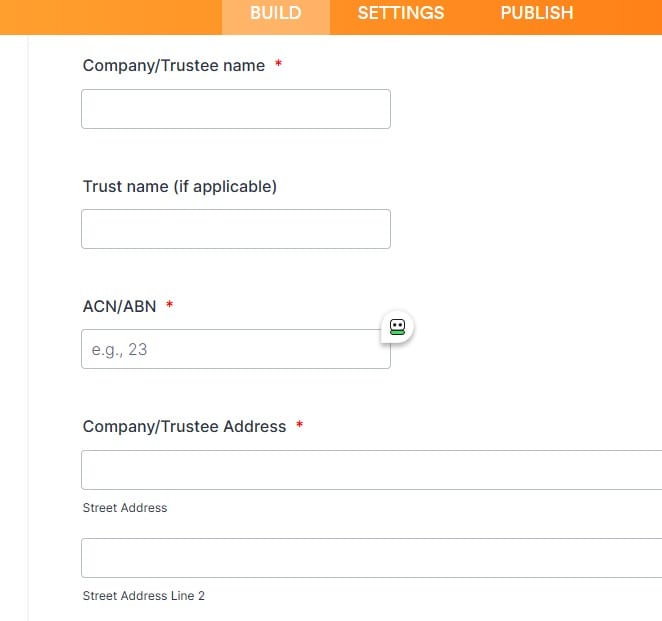
Collecting this information upfront significantly reduced compliance‑related follow‑ups.
Trust Onboarding Path
For trust structures, additional sections appear to capture:- Trust name
- Trust type (e.g. discretionary or unit trust)
- Trustee details (individual or corporate)
- Beneficiary information
- Secure upload of the trust deed

Services & Engagement Details
All clients, regardless of structure, are asked to confirm:- Required services (tax returns, BAS, payroll, advisory)
- Preferred contact details
- Referral source
The Outcome
By replacing phone calls and emails with a smart Jotform workflow, the firm achieved:
- Faster and more consistent client onboarding
- Reduced back‑and‑forth with new clients
- Improved data accuracy across business structures
- A more professional and streamlined client experience
- Time savings for staff through reduced manual data entry
Our clients found the process easier to understand and appreciated only being asked questions relevant to their situation.
Jotform provided the flexibility needed to handle multiple Australian business structures while remaining easy for both clients and staff to use. The no‑code builder allowed the form to be refined over time as requirements changed, without introducing technical complexity.
This project highlights how thoughtfully designed online forms can have a huge impact on day‑to‑day operations. By using conditional logic and a client‑centric approach, onboarding became faster, clearer, and far less admin‑heavy. If your business is still relying on PDFs or email questionnaires for client onboarding, a solution like this can deliver immediate efficiency gains while improving the overall client experience.